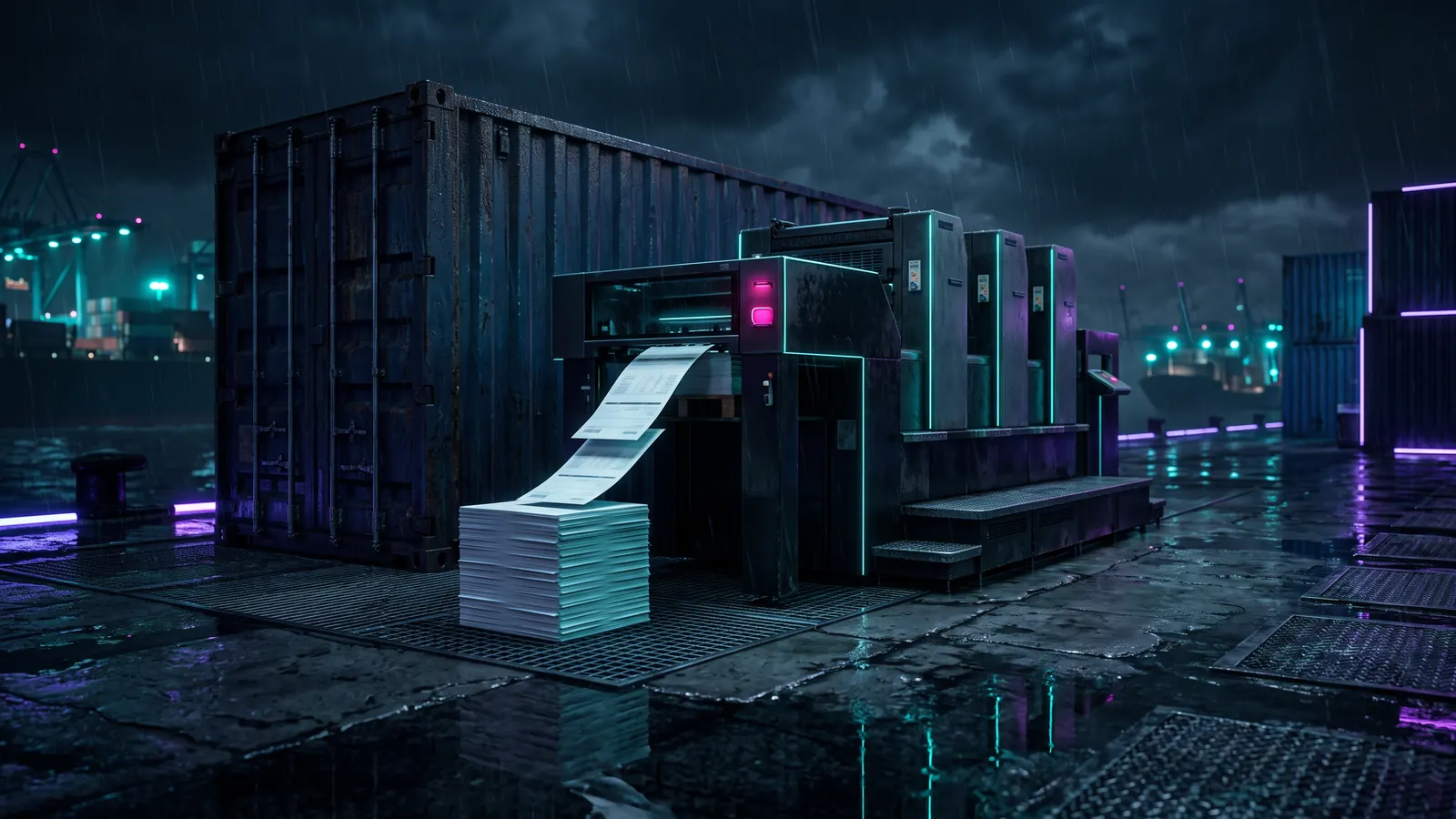
Assemble the document. Do not write it.
Building a document from data you already hold is one of the safest and most valuable things to automate. Having a model write the words inside it is one of the least safe. The distinction between assembly and composition is the whole of this page.
Assembly and composition are different problems
Assembly is taking the customer, the scope, the line items and the terms you already hold and putting them into a document with your letterhead on it. Deterministic, checkable, and it will be right every time.
Composition is having something write the paragraph that explains the recommendation. That is a judgement, it will be plausible whether or not it is correct, and someone has to read every word to find out.
If checking the output takes as long as writing it, the tool has moved the work rather than removed it.
What assembly removes
The half hour of copying between a job record and a template. The version where last client’s name survives in paragraph three. The proposal that went out with the old rates because somebody used the wrong file.
Those errors are not carelessness — they are what happens when a document is assembled by hand from four sources under time pressure. Removing the manual copying removes the class of error entirely.
- KNDR·01One source of truthRates, terms and boilerplate live in one place and every document draws from it. No stale copies.
- KNDR·02The letterhead problem, solvedAddress changes once, not across nineteen Word files that someone finds later.
- KNDR·03Conditional sectionsClauses that appear only when relevant. Deterministic rules, not judgement.
- KNDR·04Generated from the jobNot re-typed from it — which is the same argument as quote-to-invoice.

Where a model does belong
Summarising something long into something short, where a human then reads and edits it. Turning a voice note recorded on the drive home into a structured draft. Both of those save real time and both keep a person in the loop.
What they have in common is that the human is the author and the model is doing the first pass. Reverse that — model authors, human skims — and you will eventually send something wrong to someone who matters.
The number that has to be right
On a quote, the price. It should come from your rates and your job data through arithmetic you can inspect, never from anything that generates.
This is worth being firm about because it is where the sales pitch is loudest. An AI-generated quote demos beautifully. A model that is right most of the time is strictly worse than a template that is right every time, and pricing is the one place "most of the time" is unacceptable.
Where this does not pay
If you send four proposals a year, the build costs more than the copying. Frequency is the test, as it is throughout — low-frequency, high-judgement work is the worst quadrant.
And if your documents differ substantially every time because the work genuinely does, you are automating variety, which mostly produces a template with so many conditional branches that nobody can maintain it.
The tell is the number of exception cases. Three or four is a template. Fifteen means each document is genuinely bespoke, and the honest advice is to improve the source material rather than the assembly — better notes beat better templates.
Where it does pay, it pays quietly and repeatedly, which is the pattern for most of what we build. The full argument for connecting rather than replacing is on custom vs off-the-shelf.
What we have not measured, and what we would measure for you
There is no reliable published Australian figure for how long assembling proposals and reports by hand takes in a small business, and we are not going to borrow one from a vendor whitepaper to make this page more persuasive. Most numbers you will see quoted for this were produced by companies selling the fix.
What we would do instead is count it on one of your jobs. Follow a single job end to end, note every time a human touches this step, and multiply by what that person costs loaded. That is a real number about your business and it takes an afternoon.
You can run the arithmetic yourself first — the leak calculator uses ABS, Average Weekly Earnings, Australia, May 2026 for the wage default and ATO, Super guarantee, current rate for super, and returns a range rather than a single confident figure. If the range comes back under our minimum engagement, that is a real answer and you should stop there.
The questions people actually ask.
01Why not let AI write the whole proposal?
Because you would then read every line to check it, which is most of the time you were saving, and the one time you do not read carefully is the time it is wrong in front of a client. Assembly is boring and it is right every time.
02Where are your case studies?
Not published, because we do not have measured before-and-after numbers we can stand behind yet, and a case study without them is a story. Kindra AI was founded in 2025. When the measurements exist they will appear here with the sample size attached.

Stop bending.
Start shipping.
Bring the one flow that keeps costing you a Tuesday afternoon. We map it live and tell you what we'd build, what we wouldn't, and what it costs.