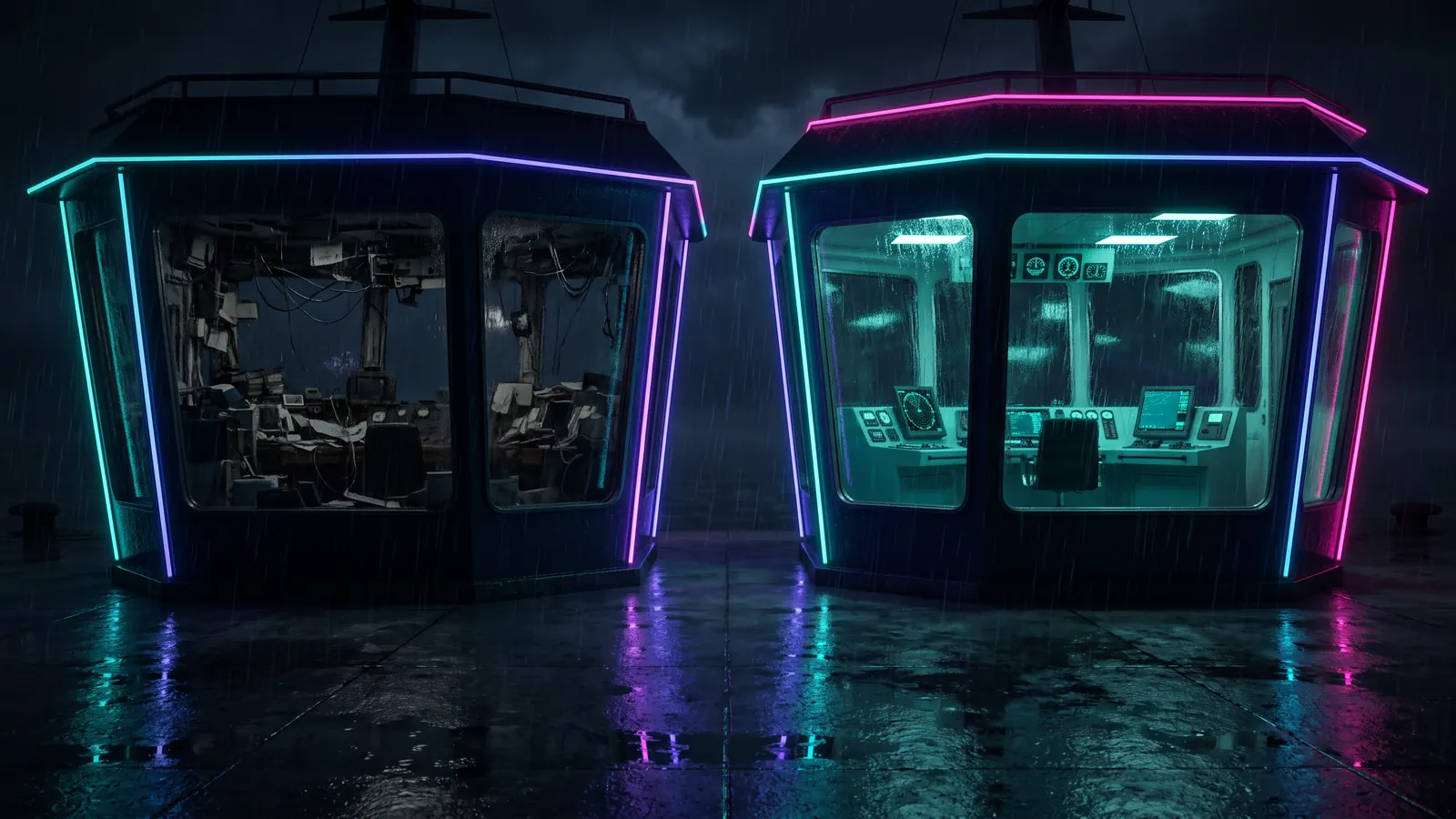
Three questions filter most of the market.
Ask for the code. Ask where it’s hosted. Ask what happens if they disappear. Most automation vendors fail at least one of those, and the answers tell you more than any portfolio. Here’s the full list, including the questions that would make us uncomfortable.
The three questions that filter most of the market
Ask these first. They take two minutes and they remove most of the field.
- KNDR·01Who owns the code, and from when?You want ownership, and you want a point in time. "At the end" is weaker than it sounds if the end never formally arrives.
- KNDR·02Where is it hosted, and in whose account?A named provider and region, in an account you can access. Anything vaguer is a dependency wearing a system’s clothes.
- KNDR·03What happens if you disappear?The only good answer is that you already hold everything you would need. If the answer involves them doing something, it is not an answer.
Ownership: what to demand in writing
Not a licence, not a perpetual right to use — assignment of ownership, with a trigger. Ask to see the clause before you sign anything, and read it yourself rather than accepting a summary.
Then ask a second question most people skip: what happens to ownership if the project stops halfway. A fair answer gives you what has been delivered and paid for.
Watch for the difference between owning the code and being able to use it. Some contracts assign ownership of bespoke work while the system depends on a proprietary layer you only license. You then own something that does not run. Ask specifically whether any component stops working if the relationship ends.
Hosting and data: where it lives, who sees it
Provider, region, and whether Australian residency is available if you need it. Then: what leaves that boundary, and when.
If AI is involved, ask specifically which provider processes your data and what that provider’s terms permit. Anyone who answers that with a general reassurance rather than a named provider has not read the terms either.
Then ask what actually crosses the boundary, and when. In most builds the answer should be very little — rules-based work makes no external call at all. Our own answer is set out on the ownership and security page, including the parts we cannot claim.
Experience vs enthusiasm — how to tell
Enthusiasm talks about what the technology can do. Experience talks about what it does on a bad day, in a real business, three years in.
A useful probe: ask about something they built that did not work out. Anyone who has shipped systems has one. A firm with no failures has either not shipped much or is not telling you.
The second probe is maintenance. Ask what happens to a system they built three years ago. Firms that have never had to live with their own work talk about builds; firms that have talk about the years afterwards, which is where nearly all the cost sits.

Questions that would make us uncomfortable
In fairness, here are the ones we would rather you did not ask — which is precisely why you should.
- KNDR·01"How many engagements have you actually delivered?"Kindra AI was founded in 2025. The systems experience behind it is long; the firm is not. Ask, and weigh it.
- KNDR·02"Who else works here?"It is a small firm. For some projects that is wrong, and we will say so — but you should ask rather than assume depth.
- KNDR·03"Have you been assessed against the Australian Privacy Principles?"We have not, and we say so on the ownership page. If you need an assessed supplier, that is a real reason to pick someone else.
- KNDR·04"What is your uptime measured over?"Ours is 100% — over eleven months. That is a short window and the number should be read with the window attached.
What a fair contract looks like
Ownership with a named trigger. Scope with named exclusions. Increments rather than one date. A defined handover list. An exit path with no penalty for leaving.
None of that is exotic. It is simply what a contract looks like when it was written to be read rather than to be signed.
If you are sanity-checking a specific proposal rather than a firm, the nine red flags is the companion to this page and works line by line through a quote. And the pricing structure that sits behind a fair contract is on how we charge.
Walking away well
If the answers do not hold up, say so plainly and stop. You do not owe a vendor a long explanation, and dragging it out costs you both.
And if a firm tells you on the first call that you do not need what they sell — take that seriously. It is the cheapest honest advice you will get, and it is the answer more often than the industry admits.
The questions people actually ask.
01Isn’t this list written to favour you?
Partly, and you should read it that way — we designed our terms around these questions, so of course we pass them. That is also why we included the four above that we do not pass comfortably. Ask every firm the same set, ours included.
02What if they won’t answer these?
That is an answer. Ownership, hosting and continuity are not commercially sensitive; a firm that will not put them in writing is telling you what the contract will feel like later.

Stop bending.
Start shipping.
Bring the one flow that keeps costing you a Tuesday afternoon. We map it live and tell you what we'd build, what we wouldn't, and what it costs.